Productivity & Health
I found the first luxury chair that actually fixed my back pain — and I’ve tried everything
A quiet discovery spreading through the executive world — and why, once you understand it, you can’t go back to anything else
I need to say this upfront: I am not easily impressed by chairs.
I’ve owned the Herman Miller Aeron. The Steelcase Leap. I’ve spent over a thousand dollars on what the industry told me were the gold standard of ergonomic seating.
And every single afternoon, by around three o’clock, my back still hurt.
So when a friend leaned across a dinner table and told me he’d fixed his — not managed it, not reduced it, fixed it — I did what any sensible person does after years of failed solutions. I nodded politely and changed the subject.
He didn’t let me.
“There’s this chair,” he said. “British company. Nobody’s heard of them. I came across it through a founders’ dinner. I looked at the price, thought it was marketing nonsense, then someone lent me one for a week.”
“My afternoon pain was gone by day three.”
He showed me a photo on his phone. My first reaction was purely visual — this did not look like an office chair. It looked like something from the interior of a high-end car. Every material chosen deliberately. A steel frame. Upholstery that looked handstitched.
And on the back of the chair, something I’d never seen before: a rail system. Two support points mounted on a precision track.
“What is that?” I asked.
“That’s why it works,” he said. “That’s the entire thing.”
Why the Expensive Chairs Didn’t Work Either
Here is what he explained to me — and what I’ve since verified myself.
Every major ergonomic chair on the market, regardless of price, is built around a single idea: support your lower back. That’s it. That’s the philosophy. That’s where the engineering goes.
Your spine, however, isn’t just a lower back.
And by mid-afternoon, the parts your chair isn’t supporting have been quietly collapsing for hours. Your upper back rounds. Your head drifts forward. Your neck tightens trying to compensate.
That is not bad posture.
That is physics.
It is a predictable physical consequence of a chair that leaves two thirds of your spine to manage entirely on its own. Recent research in occupational ergonomics has confirmed this gap in conventional seating design.
I’d spent three years blaming myself. My posture. My core. My age.
The problem was the architecture of every chair I’d ever bought — including the expensive ones.
“I couldn’t believe I’d spent $1,500 on a chair that was only solving part of the problem. Once someone explains it, it’s obvious — but nobody tells you.”
— Marketing director, switched from Herman Miller Aeron
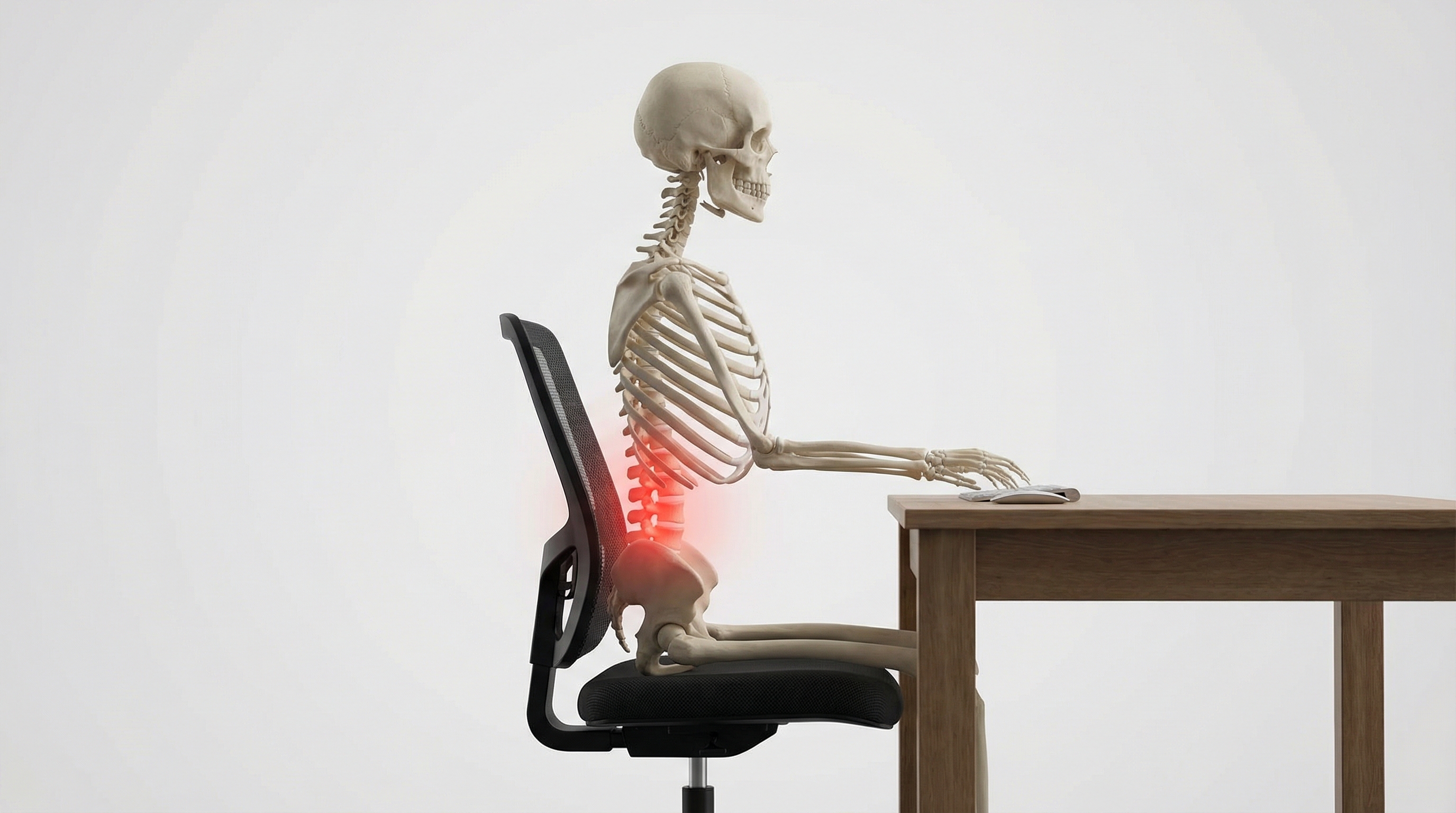
 The Science of Sitting: Why Your Body Wasn’t Designed for Office Chairs
New research from Stanford’s biomechanics lab reveals what really happens to your spine during an 8-hour workday.
March 2026
The Science of Sitting: Why Your Body Wasn’t Designed for Office Chairs
New research from Stanford’s biomechanics lab reveals what really happens to your spine during an 8-hour workday.
March 2026
The Chiropractor, the Standing Desk, and Everything Else I Tried
I’ve been through the list.
The chiropractor put things right twice a week — and within hours of sitting back down, the chair undid it. The standing desk moved the problem, didn’t solve it. The lumbar pillow helped my lower back while doing nothing for my neck.
The kneeling chair lasted two days.
None of it was useless. But none of it solved what was actually happening: my whole spine needed to stay in alignment through a full eight-hour day, not just the part my chair happened to support.
After three years and thousands of dollars, I finally understood why nothing had worked.
I’d been buying partial solutions to a whole problem.
What the Rail System Actually Does
The DuelHawk Ultra 2 is built around one idea no other chair company has pursued: two support points, moving together on a single rail, keeping your entire spine in coordination all day.
One sits at your lower back. One supports your neck. Both slide along precision rails to match your exact anatomy, and both move together when you recline or shift.
Your spine is never left with an unsupported zone.
Your muscles never have to compensate for what the chair isn’t doing.
That’s the whole difference. Not a feature. An architecture. And it’s patented — no other chair has it.
In pressure mapping studies, lower back muscle activity dropped 73% compared to standard ergonomic chairs. Not marginally better — a categorically different physical experience.
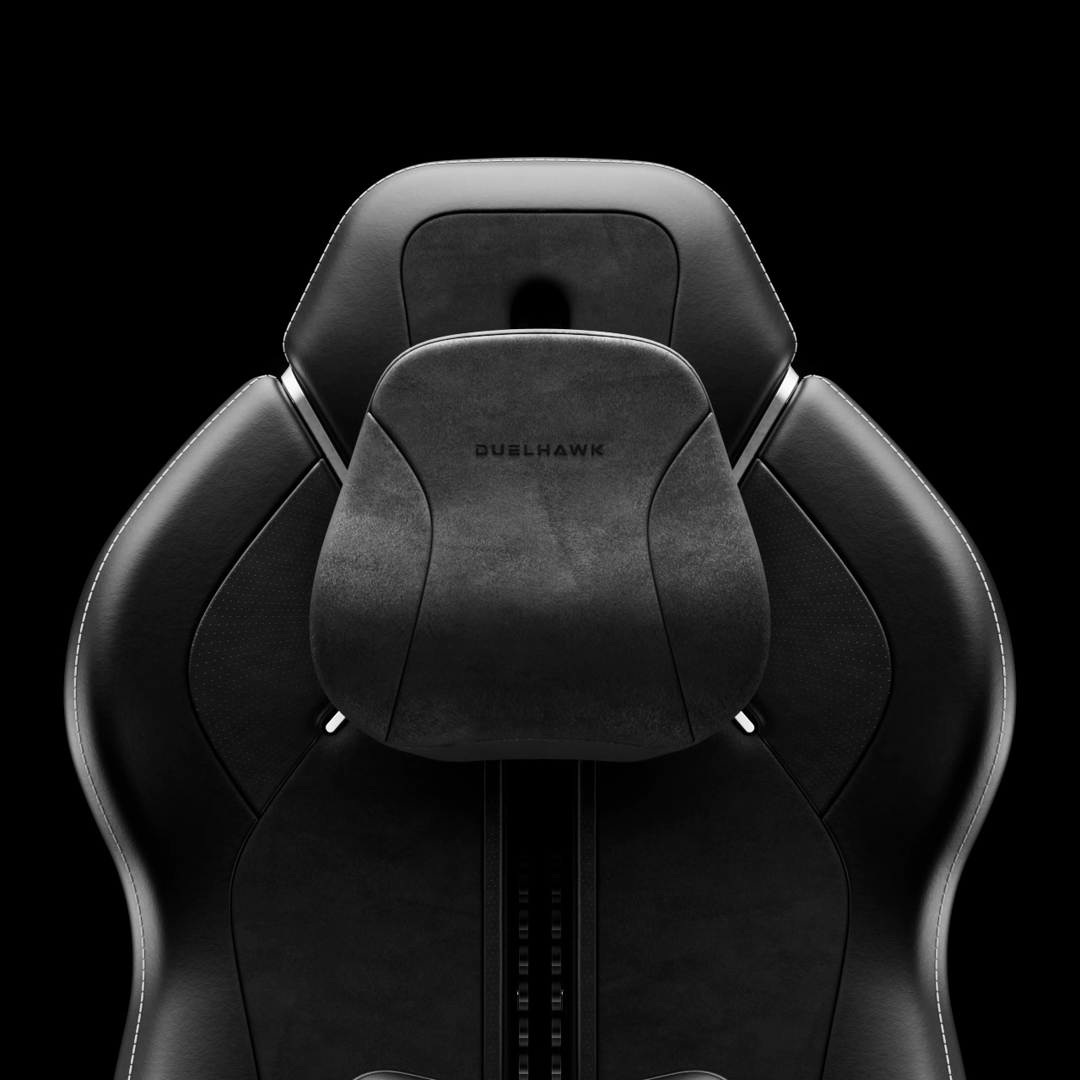
Video: DuelHawk engineering team explains the dual-rail mechanism.
“First week, my afternoon pain stopped. Not reduced — stopped. I didn’t realise how hard my muscles were working until they finally didn’t have to.”
— Software engineer, 10–12 hours daily
You May Also Like



What Happened When I Sat In It
The chair arrived on a Tuesday. The materials were immediately different — not “office chair premium,” a different category entirely.
The steel frame had no flex. The upholstery felt handmade. Setting the two rail positions took thirty seconds.
I started working at nine in the morning.
By noon I realised I hadn’t shifted in my seat once. In any chair I’d owned, I’d have reached for my lower back at least twice by then. I’d forgotten about it completely.
Three o’clock came. Nothing.
Five o’clock. Nothing.
I worked until half six — something I hadn’t done comfortably in over a year — and stood up feeling exactly as I had at nine. No stiffness. No tight neck. No “3pm face,” as my wife calls it.
I assumed placebo. New chair excitement. It would wear off.
Day two. Same.
Day three. Same.
By the end of the first week I’d had five pain-free afternoons for the first time in three years.
My wife noticed before I said anything. “You look different when you come downstairs,” she told me. “You don’t look like you’ve been in a fight.”
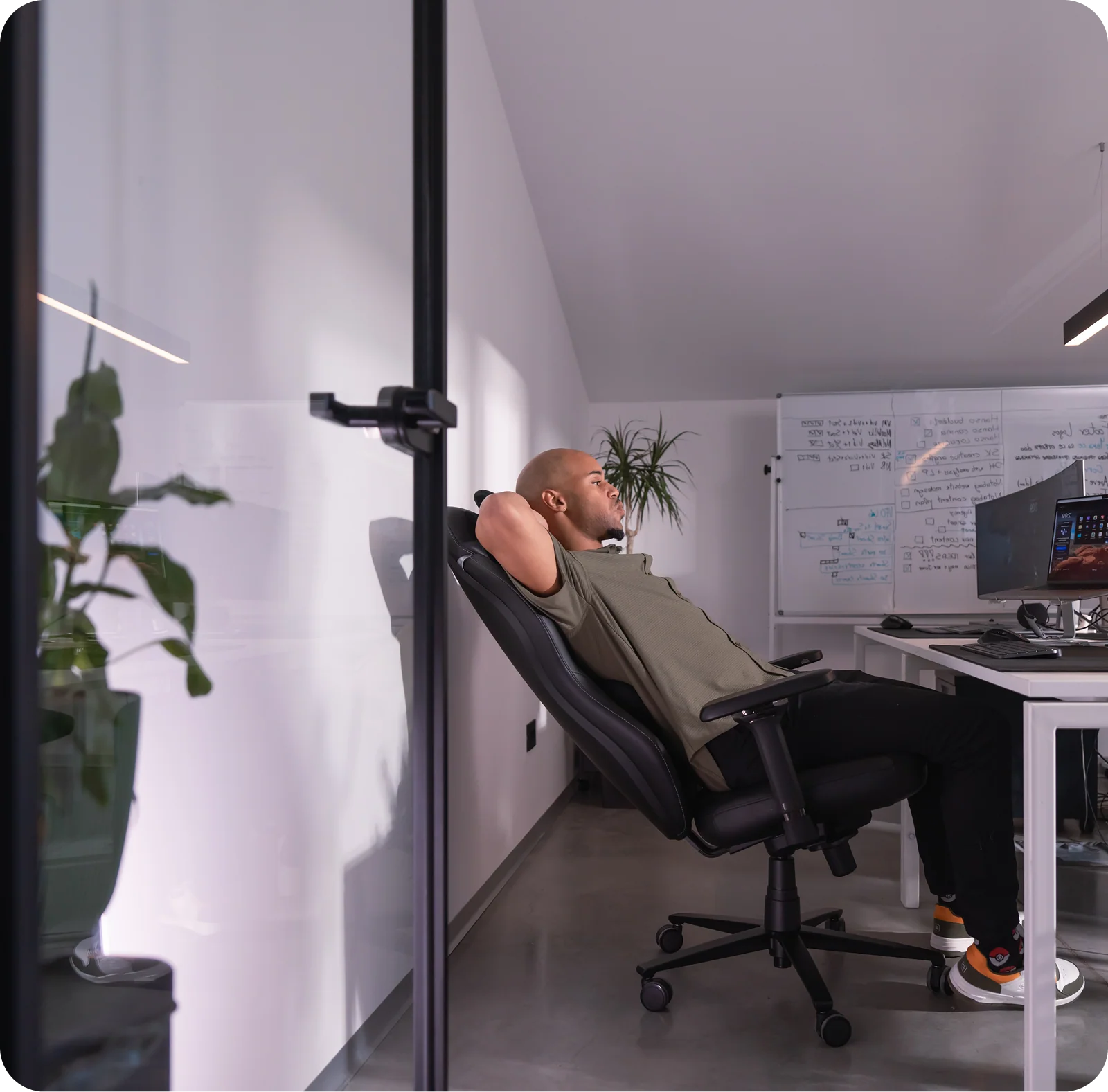
“I’ve spent $5,000 on chairs over the years. This is the first one that actually fixed the problem instead of just making it more comfortable.”
— Serial buyer, DuelHawk Ultra 2 customer
Two Months Later
The afternoon pain hasn’t come back. Not once.
I cancelled my chiropractor subscription. My Herman Miller is in the guest room.
GQ covered the DuelHawk. TechRadar, T3, Tech Advisor, and The Good Men Project all reviewed it. The consistent finding: build quality is genuinely premium, the rail mechanism works as described, and the long-session experience is in a different category from standard ergonomic chairs.
The chair industry has sold the same one-third solution for thirty years.
This is the first chair I’ve found that does the whole job.
What You Should Know Before You Decide
The Ultra 2 is $2,145. I won’t pretend that’s a casual purchase.
Here is the other number: I spent approximately $8,000 on solutions that didn’t fix it before I found this one. If I’d found this chair first, I would have saved that money and three years of daily pain.
You reserve with a $199 deposit — fully refundable at any point before your chair ships, applied to your final purchase. DuelHawk builds in limited production runs, so the deposit holds your place in the next batch.
When the chair arrives, you have 30 full days. If your 3pm pain doesn’t clearly improve, they arrange pickup. No restocking fee. No questions. Every penny back.
My only regret is the three years I spent on partial solutions before I found the one that does all of it. (You can reserve the Ultra 2 here — $199 fully refundable deposit.)
How It Compares to What You’ve Already Tried
Herman Miller and Steelcase make excellent chairs for what they were designed to do.
If supporting your lower back is enough, they’re fine products. The Ultra 2 was designed to solve a problem those chairs were never built to solve — all three zones, one connected system, 30-day full-refund trial with no restocking fee.
Once you’ve sat in a chair that does the whole job, going back to one that doesn’t becomes very difficult to justify.
“I came from a Herman Miller. This is a completely different experience. My back just doesn’t hurt anymore.”
— DuelHawk Ultra 2 customer
$199 Refundable Deposit · 30-Day Trial · Free Returns
Reserve the DuelHawk Ultra 2 → duelhawk.com